Showing posts with label AX2012. Show all posts

Sunday, May 8, 2022

How to move AX2012 attachment files to SharePoint while upgrading database to D365FO

Problem

When it comes to upgrading attachments from AX2012 to D365FO, only URLs, notes, and files saved in the former's database may be transferred to the Azure Blob Storage (on-cloud). 

Therefore, all files from attachments in AX2012 should be moved to the database first in order to be successfully migrated to D365FO.

What if there are millions of them? Technically speaking it might be a good option to save them on SharePoint (on-cloud); however, unfortunately, such attachments links will be deleted, too.

You can find more detail on Document management in D365FO in https://docs.microsoft.com/en-us/dynamics365/fin-ops-core/fin-ops/organization-administration/configure-document-management

Technical details

During the Ax2012-D365FO database upgrade process, among other standard classes ('scripts') ReleaseUpdateDB72_Docu is triggered, which actually deletes records in DocuValue and related tables for all files not saved in the data base including even those referenced on a local SharePoint server.

Solution

As a solution we can move all external files referenced in AX2012 attachments to a on-cloud SharePoint server first

Then an extension to the aforementioned class must be triggered during the standard DB upgrade procedure; so that it would keep existing links and update them accordingly to a new SharePoint folder structure.


For example, we can agree that existing local folders will be reproduced on the SharePoint Server instance.


The following code must be adapted accordingly to your landscape and tested first on a small set of files in a dev environment.

Please, use it at your own risk.

[ExtensionOf(classStr(ReleaseUpdateDB72_Docu))
final class myReleaseUpdateDB72_Docu_Extension
{
    public const str myLegacy          = 'Legacy';
    public const int myActionClassId   = 118; //DocuActionURLClassId
    public const str myName            = 'Legacy attachments for ';
    public const str myHost            = 'myCompany.sharepoint.com';
    public const str mySite            = '/sites/D365FOFileShare';

    public const str myUpgradeModifiedUser = 'myAxDocUpgradeUser'; // fake user for marking records
    public const int myMaxRowsToUpdatePerStatement = 10000;

    public const str myPart1 = "https://myCompany.sharepoint.com/sites/D365FOFileShare/Legacy/";
    public const str myPart2 = "https://myCompany.sharepoint.com/sites/D365FOFileShare/_api/Web/GetFileByServerRelativePath(decodedurl=''/sites/D365FOFileShare/Legacy/";
    public const str myPart3 = "'')";
    public const str myPart4 = "/";
    public const str myPart5 = ".";
    public const str myPart6 = "''";

    /// <summary>
    /// Sets a special value to File field to avoid dropping these records by standard script
    /// To be run BEFORE the script
    /// </summary>
    private void myPreUpdateDocuValue_CorrectFileLocations()
    {
        SysDictTable    docuValueTable = new SysDictTable(tableNum(DocuValue));
        SysDictTable    docuRefTable = new SysDictTable(tableNum(DocuRef));
        SysDictTable    docuTypeTable = new SysDictTable(tableNum(DocuType));
        str             sqlQuery;

        Connection connection = new Connection();
        try
        {
            int impactedRows;

            // First update all DocuValues with null files and empty path
            // these files are placed in network shared folders and must be retargeted to SharePoint server
            // with setting FILE to a dummy values so that the standard next() won't delete them
            do
            {
                    sqlQuery =
                    strFmt(@"
                    UPDATE TOP (%8) docValue
                    SET docValue.%6 = CAST('%1' AS VARBINARY)
                    FROM %2 docValue
                    JOIN %3 docRef ON docRef.%7 = docValue.%5 
                    JOIN %11 docType ON (docRef.%12 = docType.%13 and  docRef.%14 = docType.%15)
                    AND docValue.%6 IS NULL AND docValue.%9 ='' AND docValue.%10 = 0 AND docType.%16 = 0",
                    myUpgradeModifiedUser,                                                     // %1 - upgrade modified user 
                    docuValueTable.name(DbBackend::Sql),                                        // %2 - DocuValue
                    docuRefTable.name(DbBackend::Sql),                                          // %3 - DocuRef
                    docuValueTable.fieldName(fieldNum(DocuValue, ModifiedBy), DbBackend::Sql),  // %4 - DocuValue.ModifiedBy
                    docuValueTable.fieldName(fieldNum(DocuValue, RecId), DbBackend::Sql),       // %5 - DocuValue.RecId
                    docuValueTable.fieldName(fieldNum(DocuValue, File), DbBackend::Sql),        // %6 - DocuValue.File
                    docuRefTable.fieldName(fieldNum(DocuRef, ValueRecId), DbBackend::Sql),      // %7 - DocuRef.ValueRecId
                    myMaxRowsToUpdatePerStatement,                                             // %8 - Max rows to update per statement
                    docuValueTable.fieldName(fieldNum(DocuValue, PATH), DbBackend::Sql),        // %9 - DocuRef.PATH
                    docuValueTable.fieldName(fieldNum(DocuValue, Type), DbBackend::Sql),        // %10 - DocuValue.Type
                    docuTypeTable.name(DbBackend::Sql),                                         // %11 - docuTypeTable
                    docuRefTable.fieldName(fieldNum(DocuRef, TypeId), DbBackend::Sql),          // %12 - DocuRef.TypeId
                    docuTypeTable.fieldName(fieldNum(DocuType, TypeId), DbBackend::Sql),        // %13 - DocuType.TypeId
                    docuRefTable.fieldName(fieldNum(DocuRef,ACTUALCOMPANYID), DbBackend::Sql),  // %14 - DocuType.ACTUALCOMPANYID
                    docuTypeTable.fieldName(fieldNum(DocuType, DATAAREAID), DbBackend::Sql),    // %15 - DocuType.DATAAREAID
                    docuTypeTable.fieldName(fieldNum(DocuType, FILEPLACE), DbBackend::Sql)      // %16 - DocuType.FILEPLACE
                    );       

                impactedRows = this.myExecuteSQL(sqlQuery, connection);
            }
            while (impactedRows == myMaxRowsToUpdatePerStatement);

        }
        finally
        {
            connection.finalize();
        }
    }

    /// <summary>
    /// Nulls FILE field back and updates other field to keep SharePoint links correctly
    /// To be run AFTER the script
    /// </summary>
    private void myPostUpdateDocuValue_CorrectFileLocations()
    {
        SysDictTable    docuValueTable = new SysDictTable(tableNum(DocuValue));
        SysDictTable    docuRefTable = new SysDictTable(tableNum(DocuRef));
        SysDictTable    docuTypeTable = new SysDictTable(tableNum(DocuType));
        str             sqlQuery;

        Connection connection = new Connection();
        try
        {
            int impactedRows;

            // First update all premarked DocuRef with the new SharePoint docuType
            do
            {
                    sqlQuery =
                    strFmt(@"
                    UPDATE TOP (%8) docRef
                    SET 
                    docRef.%17 = '%21' + '_' + docRef.%18
                    FROM %3  docRef
                    JOIN %2 docValue ON docRef.%7 = docValue.%5 AND docValue.%6 = CAST('%1' AS VARBINARY) and docRef.%17 <> '%21' + '_' + docRef.%18",
                    myUpgradeModifiedUser,                                                      // %1 - upgrade modified user 
                    docuValueTable.name(DbBackend::Sql),                                        // %2 - DocuValue
                    docuRefTable.name(DbBackend::Sql),                                          // %3 - DocuRef
                    docuValueTable.fieldName(fieldNum(DocuValue, Type), DbBackend::Sql),        // %4 - DocuValue.Type
                    docuValueTable.fieldName(fieldNum(DocuValue, RecId), DbBackend::Sql),       // %5 - DocuValue.RecId
                    docuValueTable.fieldName(fieldNum(DocuValue, File), DbBackend::Sql),        // %6 - DocuValue.File
                    docuRefTable.fieldName(fieldNum(DocuRef, ValueRecId), DbBackend::Sql),      // %7 - DocuRef.ValueRecId
                    myMaxRowsToUpdatePerStatement,                                             // %8 - Max rows to update per statement
                    docuValueTable.fieldName(fieldNum(DocuValue, PATH), DbBackend::Sql),        // %9 - DocuRef.PATH
                    docuValueTable.fieldName(fieldNum(DocuValue, StorageProviderId), DbBackend::Sql),       // %10 - DocuRef.StorageProviderId
                    docuValueTable.fieldName(fieldNum(DocuValue, AccessInformation), DbBackend::Sql),      // %11 - DocuRef.AccessInformation
                    myPart1,                                                                       // %12 - https://myCompany.sharepoint.com/sites/D365FOFileShare/
                    myPart2,                                                                       // %13 - https://myCompany.sharepoint.com/sites/D365FOFileShare/api/Web/GetFileByServerRelativePath(decodedurl='/sites/D365FOFileShare/
                    myPart3 ,                                                                      // %14 - ')
                    myPart4 ,                                                                      // %15 - /
                    myPart5 ,                                                                      // %16 - .
                    docuRefTable.fieldName(fieldNum(DocuRef, TYPEID), DbBackend::Sql),              //%17 - DocuRef.TypeId
                    docuRefTable.fieldName(fieldNum(DocuRef, ACTUALCOMPANYID), DbBackend::Sql),     //%18 - 'SPND'
                    docuValueTable.fieldName(fieldNum(DocuValue, FILENAME), DbBackend::Sql),        // %19 - DocuValue.FILENAME
                    docuValueTable.fieldName(fieldNum(DocuValue, FILETYPE), DbBackend::Sql),        // %20 - DocuValue.FILETYPE
                    myLegacy                                                                       // %21 - 'Legacy'
                    );       
                impactedRows = this.myExecuteSQL(sqlQuery, connection);
            }
            while (impactedRows == myMaxRowsToUpdatePerStatement);

            impactedRows = 0;

            // Now update all premarked DocuValues with new paths and unmark them
            do
            {
                sqlQuery =
                    strFmt(@"
                    UPDATE TOP (%8) docValue
                    SET
                    docValue.%6 = NULL,
                    docValue.%4 = 0,
                    docValue.%10 = 2,
                    docValue.%9  = '%12'+ docRef.%18 + '%15'+ docValue.%19+'%16' + docValue.%20,
                    docValue.%11 = '%13'+ + docRef.%18 + '%15'+ docValue.%19+'%16' + docValue.%20 + '%14'
                    FROM %2 docValue
                    JOIN %3 docRef ON docRef.%7 = docValue.%5 AND docValue.%6 = CAST('%1' AS VARBINARY)",
                    //@myPart1 + dr.ACTUALCOMPANYID + @myPart4 + dv.FILENAME+ @myPart5 + dv.FILETYPE
                    myUpgradeModifiedUser,                                                      // %1 - upgrade modified user
                    docuValueTable.name(DbBackend::Sql),                                        // %2 - DocuValue
                    docuRefTable.name(DbBackend::Sql),                                          // %3 - DocuRef
                    docuValueTable.fieldName(fieldNum(DocuValue, Type), DbBackend::Sql),        // %4 - DocuValue.Type
                    docuValueTable.fieldName(fieldNum(DocuValue, RecId), DbBackend::Sql),       // %5 - DocuValue.RecId
                    docuValueTable.fieldName(fieldNum(DocuValue, File), DbBackend::Sql),        // %6 - DocuValue.File
                    docuRefTable.fieldName(fieldNum(DocuRef, ValueRecId), DbBackend::Sql),      // %7 - DocuRef.ValueRecId
                    myMaxRowsToUpdatePerStatement,                                             // %8 - Max rows to update per statement
                    docuValueTable.fieldName(fieldNum(DocuValue, PATH), DbBackend::Sql),        // %9 - DocuRef.PATH
                    docuValueTable.fieldName(fieldNum(DocuValue, StorageProviderId), DbBackend::Sql),       // %10 - DocuRef.StorageProviderId
                    docuValueTable.fieldName(fieldNum(DocuValue, AccessInformation), DbBackend::Sql),      // %11 - DocuRef.AccessInformation
                    myPart1,                                                                       // %12 - https://myCompany.sharepoint.com/sites/D365FOFileShare/
                    myPart2,                                                                       // %13 - https://myCompany.sharepoint.com/sites/D365FOFileShare/api/Web/GetFileByServerRelativePath(decodedurl='/sites/D365FOFileShare/
                    myPart3 ,                                                                      // %14 - ')
                    myPart4 ,                                                                      // %15 - /
                    myPart5 ,                                                                      // %16 - .
                    docuRefTable.fieldName(fieldNum(DocuRef, TYPEID), DbBackend::Sql),              //%17 - DocuRef.TypeId
                    docuRefTable.fieldName(fieldNum(DocuRef, ACTUALCOMPANYID), DbBackend::Sql),     //%18 - 'SPND'
                    docuValueTable.fieldName(fieldNum(DocuValue, FILENAME), DbBackend::Sql),        // %19 - DocuValue.FILENAME
                    docuValueTable.fieldName(fieldNum(DocuValue, FILETYPE), DbBackend::Sql),        // %20 - DocuValue.FILETYPE
                    myLegacy                                                                       // %21 - 'Legacy'
                    );
                impactedRows = this.myExecuteSQL(sqlQuery, connection);
            }
            while (impactedRows == myMaxRowsToUpdatePerStatement);

        }
        finally
        {
            connection.finalize();
        }
    }

    /// <summary>
    /// Updates document reference and value records to handle file storage in the cloud.
    /// </summary>
    [
        UpgradeScriptDescription("Updates document value records to handle file storage in the cloud"),
        UpgradeScriptStage(ReleaseUpdateScriptStage::PostSync),
        UpgradeScriptType(ReleaseUpdateScriptType::PartitionScript),
        UpgradeScriptTable(tableStr(DocuRef), false, true, true, false),
        UpgradeScriptTable(tableStr(DocuValue), false, true, true, true)
    ]
    public void updateDocuValue_CorrectFileLocations()
    {
        this.myPreUpdateDocuValue_CorrectFileLocations();
        next updateDocuValue_CorrectFileLocations();
        this.myPostUpdateDocuValue_CorrectFileLocations();
    }

    /// <summary>
    /// Updates document type records to handle file storage in the cloud.
    /// </summary>
    [
        UpgradeScriptDescription("Updates document type records to handle file storage in the cloud"),
        UpgradeScriptStage(ReleaseUpdateScriptStage::PostSync),
        UpgradeScriptType(ReleaseUpdateScriptType::PartitionScript),
        UpgradeDependsOnTaskAttribute(methodStr(ReleaseUpdateDB72_Docu, updateDocuValue_CorrectFileLocations)),
        UpgradeScriptTable(tableStr(DocuType), false, true, true, false)
    ]
    public void updateDocuType_CorrectFilePlacement()
    {
        next updateDocuType_CorrectFilePlacement();
        this.myCreateNewDocuType();
    }

    /// <summary>
    /// Executes the provided SQL statement.
    /// </summary>
    /// <param name="_sqlStatement">The SQL statement to execute.</param>
    /// <param name="_connection>The SQL connection to use; otherwise a new connection will be created.</param>
    /// <returns>The number of rows impacted by the statement.</returns>
    private int myExecuteSQL(str _sqlStatement, Connection _connection = null)
    {
        Connection sessionConn = _connection ? _connection : new Connection();
        try
        {
            Statement statement     = sessionConn.createStatement();
            new SqlStatementExecutePermission(_sqlStatement).assert();
            int impactedRows = statement.executeUpdate(_sqlStatement);
            statement.close();
            CodeAccessPermission::revertAssert();
            return impactedRows;
        }
        finally
        {
            if (!_connection)
            {
                sessionConn.finalize();
            }
        }
    }

    /// <summary>
    /// gets a Set of all legal entities present in the staging
    /// </summary>
    /// <returns>Set</returns>
    public Set getCompanySet()
    {
        DocuRef docuRef;
        Set companySet = new Set(Types::String);
        while select ActualCompanyId from docuRef
            group by ActualCompanyId
        {
            companySet.add(docuRef.ActualCompanyId);
        }
        return companySet;
    }

    /// <summary>              
    /// Creates new DocuType records for legacy attachment moved now to SharePoint 
    /// </summary>
    private void myCreateNewDocuType()
    {
        Set             companySet  = this.getCompanySet();
        SetEnumerator   se          = companySet.getEnumerator();
        DocuType        documentType;
        ttsbegin;
        while (se.MoveNext())
        {
            SelectableDataArea currCompany = se.current();
            changecompany(currCompany)
            {
                DocuTypeId typeId = myLegacy+'_'+currCompany;
                if(!DocuType::exist( typeId))
                {
                    documentType.clear();
                    documentType.TypeGroup                  = DocuTypeGroup::File;
                    documentType.RemoveOption               = DocuRemoveOption::DocumentAndFile;
                    documentType.FileRemovalConfirmation    = NoYes::Yes;
                    documentType.TypeId                     = typeId;
                    documentType.ActionClassId              = myActionClassId; //DocuActionURLClassId
                    documentType.Name                       = myName+currCompany;
                    documentType.FilePlace                  = DocuFilePlace::SharePoint;
                    documentType.Host                       = myHost;
                    documentType.Site                       = mySite;
                    documentType.FolderPath                 = myLegacy+'/'+currCompany;
                    documentType.doInsert();
                }
            }
        }                     
        ttscommit;
    }

}]

Friday, July 2, 2021

Some ISV/Custom labels not resolved when migrated from AX 2012 to D365FO

 After migration from AX 2012 to D365FO I noticed a strange thing with one ISV module labels.

Some of them are perfectly resolved by their old notation with @ in the reference; but none in a new style.


As suggested by Muthusamy V in this old thread https://community.dynamics.com/365/financeandoperations/f/dynamics-365-for-finance-and-operations-forum/312828/label-issues-in-sdp-deployment?pifragment-109037=2#responses

and explained by one of my colleagues, I simply need to delete these files from K:\AosService\PackagesLocalDirectory\ApplicationSuite\ folder. (All D365FO service must be stopped)


Then it works well.


Wednesday, July 29, 2020

How to get a list of the Tables maintained by Change Tracking in SQL

Thanks to Brent Ozar and Dave Phillips who showed us how to get a list of the Tables maintained by Change Tracking directly in MS SQL Server Management Studio. It works for both AX2012 and D365 versions.


SET TRANSACTION ISOLATION LEVEL READ UNCOMMITTED;
GO
SELECT
   sct1.name AS CT_schema,
   sot1.name AS CT_table,
   ps1.row_count AS CT_rows,
   ps1.reserved_page_count*8./1024. AS CT_reserved_MB,
   sct2.name AS tracked_schema,
   sot2.name AS tracked_name,
   ps2.row_count AS tracked_rows,
   ps2.reserved_page_count*8./1024. AS tracked_base_table_MB,
   change_tracking_min_valid_version(sot2.object_id) AS min_valid_version
FROM sys.internal_tables it
JOIN sys.objects sot1 ON it.object_id=sot1.object_id
JOIN sys.schemas AS sct1 ON sot1.schema_id=sct1.schema_id
JOIN sys.dm_db_partition_stats ps1 ON it.object_id = ps1. object_id AND ps1.index_id in (0,1)
LEFT JOIN sys.objects sot2 ON it.parent_object_id=sot2.object_id
LEFT JOIN sys.schemas AS sct2 ON sot2.schema_id=sct2.schema_id
LEFT JOIN sys.dm_db_partition_stats ps2 ON sot2.object_id = ps2. object_id AND ps2.index_id in (0,1)
WHERE it.internal_type IN (209, 210)
order by tracked_name
;

GO


Friday, June 14, 2019

How to enable a few fields on a form data source

/// <summary>
/// Helper for form data source functionality
/// </summary>
class FormDataSourceHelper
{
    /// <summary>
    /// Allow edit for given fields only; the rest is non-editable
    /// </summary>
    /// <param name = "_fds">Caller form data source</param>
    /// <param name = "_fields">Container with fields numbers for allowing</param>
    public static client void allowEditFields(FormDataSource _fds, container _fields)
    {
        DictTable                           dictTable;
        int                                 fieldCnt, fieldNumber;
        Set                                 fieldsSet;
        
        if(!_fds)
        {
            throw Error(Error::wrongUseOfFunction(funcName()));
        }

        dictTable = new DictTable(_fds.table());
        
        if(!dictTable)
        {
            throw Error(Error::wrongUseOfFunction(funcName()));
        }
        // everything is fine if we are here already

        // first convert a given container of fields numbers to a set of unique values
        fieldsSet = new Set(Types::Integer);
        for(fieldCnt = 1 ; fieldCnt <= conLen(_fields); fieldCnt++)
        {
            fieldsSet.add(conPeek(_fields, fieldCnt));
        }
        // disbale a field if it is not included in the set
        for(fieldCnt = 1 ; fieldCnt <= dictTable.fieldCnt(); fieldCnt++)
        {
            fieldNumber = dictTable.fieldCnt2Id(fieldCnt);
            if(_fds.object(fieldNumber) && !fieldsSet.in(fieldNumber))
            {
                _fds.object(fieldNumber).allowEdit(false);
            }
        }
    }

}

Wednesday, May 8, 2019

How to change status for multiple batch jobs at once

All you need to change status for multiple batch jobs at once is to move the Change status button from its menu to any place in the grid tab.


Enjoy!


Friday, April 12, 2019

Dangerous bug in CustCollectionsPoolsListPage form AX2012/D365

There is a form CustCollectionsPoolsListPage where two data sources are outer joined to the root data source with no relations (no links).


If by any reason the initial query does not contain links for these two aforementioned, SQL starts producing a Cartesian product and generating a huge temporary table. The latter can potentially lead to SQL server crash, like it happened in our environment.


The following fix may leave much to be desired but at least it creates needed links in case they are absent.

On CustTable data source we have to add an additional check for the existing query.


public void executeQuery()
{
    element.populateAgingIndicators(selectedCustAging);

    // Use the query from the cue?
    if (!useInitialQuery 
                        // Begin
                        || !this.wblCheckQuery(this.query())
                        // End: 
                        )
    {
        this.query(element.addOriginalPoolQuery(listPageHelper.getCurrentPoolQuery()));
    }


    super();

    element.setButtonAccess();
    element.setGridColumnLabels();
}


// to avoid the cartesian product in case of absent link for this outer join
private boolean wblCheckQuery(Query _query)
{
    QueryBuildDataSource custAgingDs;
    QueryBuildDataSource custAgingLegalEntityDs;
    boolean ret = true;

    custAgingDs             = _query.dataSourceName(#CustAgingDsName);
    custAgingLegalEntityDs  = _query.dataSourceName(#CustAgingLegalEntityName);
    if (!custAgingDs || !custAgingLegalEntityDs || custAgingDs.linkCount() <= 0 || custAgingLegalEntityDs.linkCount() <= 0)
    {
        ret = checkFailed("Saved query is corrupted. Try to recreate the cue");
    }
    return ret;
}

From SQL perspective we can catch such an issue by the following query.


use tempdb
select * from sys.dm_db_session_space_usage spu
join sys.dm_exec_sessions s on s.session_id = spu.session_id
join sys.dm_exec_requests r on s.session_id = r.session_id
cross apply sys.dm_exec_sql_text(sql_handle) t 
order by internal_objects_alloc_page_count desc

Friday, April 5, 2019

AX2012-D365 Bug: TrvWorkflowExpLines query misses fields

The issue appears once you post project or inter-company expenses.

Once you approved and never opened Accounting distribution form for an expense, Project activity number field will be empty, or, for the Inter-company case, even the project information will be lost.


This is how TrvWorkflowExpLines query should look like to overcome the issue.


Wednesday, April 3, 2019

Accessing FormDataSource

Say, we need to change the form data source sorting order or any other more complex change.

This is an old but good note by Vania Kashperuk about the subject in AX 2012.


public void init()
{
    super();
    this.queryBuildDataSource().addSortField(fieldNum(myDescartesInbound, RecId), SortOrder::Descending);
}


Tuesday, March 26, 2019

How to get number of rows loaded in a grid

In fact we can use numberOfRowsLoaded on a linked form data source; however, it shows the number of those cached only.

So, if you are editing row number 28, for example, and then call ExecuteQuery() on the data source, you will probably get a lower number of rows loaded in the grid yet, say, 19.

In order to get the right number, you should use the aforementioned method together with allRowsLoaded() one.

public int myNumberOfRowsLoaded()
{
    int myNumOfRec;
    int myCounter;

    myNumOfRec = PSAActivityEstimates_DS.numberOfRowsLoaded();
    // nothing to load yet
    if(!myNumOfRec)
    {
        return myNumOfRec;
    }
    // so far we numbered those lines cached only
    while(!PSAActivityEstimates_DS.allRowsLoaded())
    {
        // so let's move it on until the end of loading
        PSAActivityEstimates_DS.setPosition(myNumOfRec);
        PSAActivityEstimates_DS.getNext();
        // just to avoid never ending adventure
        if(myCounter>1000)
        {
            break;
        }
        myCounter++;
        // get the number for the next iteration
        myNumOfRec = PSAActivityEstimates_DS.numberOfRowsLoaded();
    }
    // now all numberOfRowsLoaded() calls will return the correct number of rows in grids
    myNumOfRec = PSAActivityEstimates_DS.numberOfRowsLoaded();

    return myNumOfRec;
}

Wednesday, March 6, 2019

Extended version of Universal Field Changer for Microsoft Dynamics AX2012

Oh yeah! The Field changer is still on the road! Now equipped with two updating options:


Feel free to use this surgeon's tool at your own risk! Grab it from here.

Computed column for union values from multiple outer joined data sources in view

Let's say you have a multiple outer joined data sources with similar fields, which can be merged by union to one target field.

PSAActualEntity  data entity (in D365) can be a good example, if you add ProjCostTrans, ProjItemTrans, and ProjEmplTrans to its root data source table ProjTransPosting, which has appropriate relations to each of them.


All aforementioned have CategoryId field, which can be present in one table only at a time.


 Let's place a new computed string field with the following static method with a nested if.


private static server str transCategoryId()
    {
        str         sRet;
        tableName   viewName                = identifierStr(avrPSAActualEntity);
        str         cCategoryProjCostTrans  = SysComputedColumn::comparisonField(viewName,
                                                                                    identifierStr(ProjCostTrans),
                                                                                    fieldStr(ProjCostTrans, CategoryId));
        str         cCategoryProjItemTrans  = SysComputedColumn::comparisonField(viewName,
                                                                                    identifierStr(ProjItemTrans),
                                                                                    fieldStr(ProjItemTrans, CategoryId));
        str         cCategoryProjEmplTrans  = SysComputedColumn::comparisonField(viewName,
                                                                                    identifierStr(ProjEmplTrans),
                                                                                    fieldStr(ProjEmplTrans, CategoryId));
        str         sCategoryProjCostTrans  = SysComputedColumn::returnField(viewName,
                                                                                    identifierStr(ProjCostTrans),
                                                                                    fieldStr(ProjCostTrans, CategoryId));
        str         sCategoryProjItemTrans  = SysComputedColumn::returnField(viewName,
                                                                                    identifierStr(ProjItemTrans),
                                                                                    fieldStr(ProjItemTrans, CategoryId));
        str         sCategoryProjEmplTrans  = SysComputedColumn::returnField(viewName,
                                                                                    identifierStr(ProjEmplTrans),
                                                                                    fieldStr(ProjEmplTrans, CategoryId));
        sRet =
            SysComputedColumn::if(SysComputedColumn::isNotNullExpression(cCategoryProjCostTrans),
                                    cCategoryProjCostTrans, 
                                    SysComputedColumn::if(SysComputedColumn::isNotNullExpression(cCategoryProjItemTrans),
                                                            sCategoryProjItemTrans,
                                                            SysComputedColumn::if(SysComputedColumn::isNotNullExpression(cCategoryProjEmplTrans),
                                                                                sCategoryProjEmplTrans,
                                                                                SysComputedColumn::returnLiteral('')
                                                                                )
                                                        )
                                );

        return sRet;
    }


Monday, February 25, 2019

TempDB table populated in CIL

We have multiple options to provide additional information to records in grids. Some of them, like display methods, are easy to implement. Some of them, like a temporary table, are not.

Let's consider a scenario when our lovely user wants to see reservation info directly in the transaction grid as filterable columns.


Evidently, we cannot use display methods because they cannot be filterable. Given the way this info calculated behind the curtain, there is no way to create a view to join InventTrans on InventTransItem form. So, the last feasible option is to create a temporary table and join it to the main form data source.

In order to populate this TempDB table (it is not enough to create an InMemory one) as much fast as possible, we have to run the logic in CIL.

The following shows how to work with such tables by passing their physical names.

First, create a TempDB table.


Then add it to the form data source so that it would be outer joined to InventTrans table


and place its Init() method, which links the local buffer with a populated TempDB on the SQL server side.

We also need to init its populating engine and calculate its data at least once when the form opens and maybe later via Refresh button for all or one particular item.

final class FormRun extends ObjectRun
{
    myInventSumFormEngine              myInventSumFormEngine;
}

void init()
{
    super();
    element.myInitParameters();
}

private void myInitParameters()
{
    myInventSumFormEngine               = new  myInventSumFormEngine(element);
}

//myTmpInventSum_DS.Init
public void init()
{
    myTmpInventSum                  myTmpInventSumLoc;
    myTmpInventSumLoc.doInsert();
    delete_from myTmpInventSumLoc;
    super();
    myTmpInventSum.linkPhysicalTableInstance(myTmpInventSumLoc);
}

public void run()
{
    super();
    element.myRecalcData();
}

public void myRecalcData(boolean _forCurrentItemOnly = false)
{
    myInvenTransByItemDimView  myInvenTransByItemDimView;

    if(_forCurrentItemOnly)
    {
        myInventSumFormEngine.parmItemIdCalcFor(InventTrans.ItemId);
        myInventSumFormEngine.run();
    }
    else
    {
        myInventSumFormEngine.parmItemIdCalcFor('');
        // todo: uncomment if needed to measure the execution time
        //myInventSumFormEngine.parmShowCalcInfo(true);
        startLengthyOperation();
        myInventSumFormEngine.run();
        endLengthyOperation();
    }
}

Now let's take a look at the populating class. It has parameters for showing elapsed time and run for a particular item id only.


/// <summary>
/// Populating TempDB tables in CIL
/// </summary>
/// <remarks>
/// Passing physical table names between CIL and form
/// </remarks>

public class myInventSumFormEngine
{
 // add more data sources to support multiple TempDB tables populating
 FormDataSource                      fdsTmpInventSum;
 myTmpInventSum                     myTmpInventSum;
 ItemId                              itemIdCalcFor;
 boolean                             showCalcInfo;
}

/// <summary>
/// Gets TempDB tables physical names
/// </summary>
/// <returns>
/// Container with names
/// </returns>
/// <remarks>
/// Creates buffers if not exist yet
/// </remarks>
private container getTempTablesNames()
{
 if(!myTmpInventSum.getPhysicalTableName())
 {
  select firstOnly myTmpInventSum;
 }
 return [myTmpInventSum.getPhysicalTableName()];
}

/// <summary>
/// Creates new populating engine for a given form
/// </summary>
/// <param name="_formRun">
/// Caller form
/// </param>
/// <remarks>
/// Looks for a particular data sources to link TempDB tables
/// </remarks>
public void new(FormRun _formRun = null)
{
 Object formObject = _formRun;

 if (_formRun)
 {
  fdsTmpInventSum      = _formRun.dataSource(tableId2Name(tableNum(myTmpInventSum)));
 }
}

/// <summary>
/// To calculate TempDB table for a particular item only
/// </summary>
/// <param name="_parm">
/// Item id to calculate data
/// </param>
/// <returns>
/// Item id
/// </returns>
/// <remarks>
/// If empty, then calculate for all items
/// </remarks>
public ItemId parmItemIdCalcFor(ItemId _parm = itemIdCalcFor)
{
 itemIdCalcFor = _parm;
 return itemIdCalcFor;
}

/// <summary>
/// Show consumed time to populate TempDB tables
/// </summary>
/// <param name="_parm">
/// Shows if True
/// </param>
public boolean parmShowCalcInfo(boolean _parm = showCalcInfo)
{
 showCalcInfo = _parm;
 return showCalcInfo;
}

public void run()
{
 str                     myTmpInventSumTempDBTableName;
 // add here more tempDB tables if needed
 [myTmpInventSumTempDBTableName] = this.getTempTablesNames();
 [myTmpInventSumTempDBTableName] = myInventSumFormEngine::calc([itemIdCalcFor, myTmpInventSumTempDBTableName, showCalcInfo]);
 // push calculated data back to the form data source
 if(fdsTmpInventSum)
 {
  // this assignment works only on the client tier outside of the populating method
  fdsTmpInventSum.cursor().linkPhysicalTableInstance(myTmpInventSum);
  fdsTmpInventSum.research();
 }
}

/// <summary>
/// Launcher for CIL
/// </summary>
/// <param name="_cont">
/// Container with parameters and all TempDB tables physical names to populate
/// </param>
/// <returns>
/// Container with all populated TempDB tables physical names
/// </returns>
private static server container calc(container _cont)
{
 container               cont;
 XppILExecutePermission  xppILExecutePermission;
 FromTime                startTime               = timeNow();
 ItemId                  itemIdCalcFor           = conPeek(_cont, 1);
 boolean                 showCalcInfo            = conPeek(_cont, 3);

 xppILExecutePermission = new XppILExecutePermission();
 xppILExecutePermission.assert();

 cont = runClassMethodIL(
         classStr(myInventSumFormEngine),
         staticMethodStr(myInventSumFormEngine, calcIL),
         _cont
        );
 CodeAccessPermission::revertAssert();

 if(showCalcInfo)
 {
  info(strFmt("Refreshed for %1 in %2",  itemIdCalcFor ? itemIdCalcFor : "all items", timeConsumed(startTime, timeNow())));
 }

 return cont;
}

/// <summary>
/// Implements the calculating logic and populating TempDB tables
/// </summary>
/// <param name="_con">
/// Container with parameters and all TempDB tables physical names to populate
/// </param>
/// <returns>
/// Container with all populated TempDB tables physical names
private static server container calcIL(container _con)
{
 WHSInventReserve                    whsInventReserve;
 myTmpInventSum                      myTmpInventSum;
 ItemId                              itemIdCalcFor                   = conPeek(_con, 1);
 str                                 myTmpInventSumTempDBTableName  = conPeek(_con, 2);
 myInvenTransByItemDimView           myInvenTransByItemDimView;
 // Link to an exiting table
 myTmpInventSum.useExistingTempDBTable(myTmpInventSumTempDBTableName);
 // empty existing data
 myInventSumFormEngine::cleanTmpInventSum(myTmpInventSum, itemIdCalcFor);
 /***** Implements the calculating logic here *****/
 while select whsInventReserve
  join RecId from myInvenTransByItemDimView
  where
   (!itemIdCalcFor || whsInventReserve.ItemId == itemIdCalcFor) &&
   myInvenTransByItemDimView.ItemId == whsInventReserve.ItemId &&
   myInvenTransByItemDimView.InventDimId == whsInventReserve.InventDimId
 {
  myTmpInventSum.clear();
  myTmpInventSum.Itemid                  = whsInventReserve.itemId;
  myTmpInventSum.InventDimId             = whsInventReserve.InventDimId;
  myTmpInventSum.AvailOrdered            = whsInventReserve.AvailOrdered;
  myTmpInventSum.AvailPhysical           = min(whsInventReserve.displayPhysAvailUpHierarchy(), whsInventReserve.AvailPhysical);
  // here you can add any other method calls to get more info about reservation
  myTmpInventSum.AvailReservDelta        = myTmpInventSum.AvailPhysical - myTmpInventSum.AvailOrdered;
  myTmpInventSum.insert();
 }
 // send tables physical names back to the form
 return [myTmpInventSum.getPhysicalTableName()];
}

/// <summary>
/// Empties the whole table or for given item id only
/// </summary>
/// <param name="_myTmpInventSum">
/// TempDB table buffer to empty
/// </param>
/// <param name="_itemIdCalcFor">
/// Item id
/// </param>
static private void cleanTmpInventSum(myTmpInventSum _myTmpInventSum, ItemId _itemIdCalcFor = '')
{
 delete_from _myTmpInventSum
 where
  (!_itemIdCalcFor || _myTmpInventSum.ItemId == _itemIdCalcFor);
}

As you can see the tricky point is to provide tables physical names to CIL and back in calc() and calcIL() methods.

Now you get it.


Do not forget to build CIL and check it in your Development user options.


Wednesday, January 30, 2019

View computed column to get OR for two flags

Nothing new, just to reiterate the basics.

Say, we need to add a computed column as a result of OR function over two other columns of Boolean type:myPPOFirmDisableForSalesLine and myPPOFirmDisableForTransferLine.


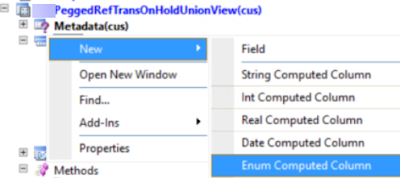
Create a new field myPPOFirmDisable as Enum Computed field


and point it to the following method.


private static server str myPPOFirmDisable(int _tableNum)
{
    DictView    ctView      = new DictView(tableNum(myPeggedRefTransOnHoldUnionView));
    str         sTransType1 = SysComputedColumn::comparisonField(identifierStr(myPeggedRefTransOnHoldUnionView), identifierStr(mySalesTableOnHoldView),  fieldStr(mySalesTableOnHoldView, myPPOFirmDisableForSalesLine));
    str         sTransType2 = SysComputedColumn::comparisonField(identifierStr(myPeggedRefTransOnHoldUnionView), identifierStr(mySalesTableOnHoldView),  fieldStr(mySalesTableOnHoldView, myPPOFirmDisableForTransferLine));
    str     sRet        = '';

    sRet =
            SysComputedColumn::or2
            (
                SysComputedColumn::equalExpression(sTransType1, SysComputedColumn::returnLiteral(NoYes::Yes)),
                SysComputedColumn::equalExpression(sTransType2, SysComputedColumn::returnLiteral(NoYes::Yes))
            );
    sRet =
        SysComputedColumn::if(sRet, SysComputedColumn::returnLiteral(NoYes::Yes), SysComputedColumn::returnLiteral(NoYes::No));

    return sRet;
}

The whole point is to create a string with an SQL statement as a result in static method. There are a lot of standard functions in SysComputedColumn class aiming to help with syntax.

As you can see in this example it is not enough to get a logical comparison result at the first sRet assigning. The latter must be converted explicitly to an SQL string as it goes at the second step.

Finally we get the following string as a part of the whole SQL statement.

CASE WHEN (T1.MYPPOFIRMDISABLEFORSALESLINE = 1) OR (T1.MYPPOFIRMDISABLEFORTRANSFERLINE = 1) THEN 1 ELSE 0 END

Wednesday, January 23, 2019

bugs in SysLookupMultiSelectGrid class and form

You can find a lot of example about how to support multiple selection lookups. AX 2012/D365 provide us with SysLookupMultiSelectGrid class and form to implement such scenarios.

There are two bugs however still existing in the standard code.

SysLookupMultiSelectGrid class, method lookup() must be as follows in order to refresh Query in case QueryRun is given.


// the standard method does not update the query in case if queryrun is given
public static void wblLookup(Query _query, FormStringControl _ctrlIds, FormStringControl _ctrlStrs, container _selectField, queryRun _queryRun = null)
{
    SysLookupMultiSelectGrid    lookupMS = new SysLookupMultiSelectGrid();

    lookupMS.parmCallingControlId(_ctrlIds);
    lookupMS.parmCallingControlStr(_ctrlStrs);
    lookupMS.parmQuery(_query);
    lookupMS.parmQueryRun(_queryRun);
    if(_queryRun)
    // Begin: Alexey Voytsekhovskiy
    {
        lookupMS.parmQuery(_queryRun.query());
    }
    // End: Alexey Voytsekhovskiy
    lookupMS.parmSelectField(_selectField);
    lookupMS.run();
}

SysLookupMultiSelectGrid form, method executeQuery() on common data source must be as follows in order not to consider referenced data sources, which may come with a given query.


public void executeQuery()
{
    QueryRun qr;
    Query lookupMultiSelectQueryCopy = new Query(lookupMS.parmQuery());
    FormRun formRun;
    FormDataSource formDataSource;
    int dsCount, i = 1;
    Common formDataSourceCursor, queryRunCursor;

    // Always use the query defined on the SysLookupMultiSelectGrid class. Note that a copy is used
    // so that any modifications made to the Query by the Form at runtime aren't fed back through
    // the next time the lookup is presented to the user. (The Query is used to define which fields
    // are present on the Form during lookup construction. Therefore, if any fields are added at runtime
    // by the Forms engine, duplicated or non-original-Query defined fields may be presented on the
    // 2nd or later presentations of the lookup if a copy isn't used.)
    this.query(lookupMultiSelectQueryCopy);

    // check if user has set any queryrun. If yes, that means the cursors are set by user explicitly,
    // usually the case where query contains tmp tables and needs to be populated.
    qr = lookupMS.parmQueryRun();
    if(qr)
    {
        formRun = this.formRun();
        dsCount = formRun.dataSourceCount();

        // get data source from query run, get the cursor and set it on the form data source cursor.
        for(i = 1; i<=dsCount; i++)
        {
            formDataSource = formRun.dataSource(i);
            if(formDataSource
                            // Begin: Alexey Voytsekhovskiy
                            // we don't need a reference data source here!
                            && !formDataSource.isReferenceDataSource()
                            // End: Alexey Voytsekhovskiy
                            )
            {
                // get form data source cursor and set the queryrun cursor as data on it.
                formDataSourceCursor = formDataSource.cursor();
                queryRunCursor = qr.get(formDataSourceCursor.TableId);
                if(queryRunCursor)
                {
                    if(queryRunCursor.isTempDb() || queryRunCursor.isTmp())
                    {
                        formDataSourceCursor.setTmpData(queryRunCursor);
                    }
                    else
                    {
                        formDataSourceCursor.data(queryRunCursor);
                    }

                }
            }
        }
    }

    super();
}

Wednesday, October 17, 2018

How to get all related table ids from code

We can loop all relations on a table by code.


static void myGetRelatedTableNames(Args _args)
{
    myInExtCodeValueTable           myInExtCodeValueTable;
    int                             mapId;
    TableName                       relatedTableName;
    TableId                         relatedTableId;
    Set                             tablesIdsSet    = new Set(Types::Integer);
    Set                             tablesNamesSet  = new Set(Types::String);
    TableId                         tableId         = tableName2id(tableStr(myInExtCodeValueTable));
    Dictionary                      dictionary      = new Dictionary();
    SysDictTable                    dictTable       = dictionary.tableObject(tableId);
    DictRelation                    dictRelation    = new DictRelation(myInExtCodeValueTable.TableId);
    int                             mapCnt          = dictTable.relationCnt();
    container                       ret ;            
    str                             relationName;
    //create a maps of literals for all tables from the table relations
    // so that we could get tables names based on their ids
    // and if any new relation will be added to multiple external codes table
    // it is present automatically in this view
    for (mapId=1; mapId <= mapCnt; mapId++)
    {
        // elaborate if any table present many times
        relationName        = dictTable.relation(mapId);
        dictRelation.loadNameRelation(relationName);
        if(dictRelation)
        {
            relatedTableId      = dictRelation.externTable();
            relatedTableName    = tableId2pname(relatedTableId);
            tablesIdsSet.add(relatedTableId);
            tablesNamesSet.add(relatedTableName);
            info(strFmt("Table %1 - %2", relatedTableId, relatedTableName));
        }
    }
        
    ret = [tablesIdsSet.pack(), tablesNamesSet.pack()];
}


It can be useful in cases when we need, say, to open a form with a related record.


Here you can find a more elaborated example.