Monday, February 25, 2019

TempDB table populated in CIL

We have multiple options to provide additional information to records in grids. Some of them, like display methods, are easy to implement. Some of them, like a temporary table, are not.

Let's consider a scenario when our lovely user wants to see reservation info directly in the transaction grid as filterable columns.


Evidently, we cannot use display methods because they cannot be filterable. Given the way this info calculated behind the curtain, there is no way to create a view to join InventTrans on InventTransItem form. So, the last feasible option is to create a temporary table and join it to the main form data source.

In order to populate this TempDB table (it is not enough to create an InMemory one) as much fast as possible, we have to run the logic in CIL.

The following shows how to work with such tables by passing their physical names.

First, create a TempDB table.


Then add it to the form data source so that it would be outer joined to InventTrans table


and place its Init() method, which links the local buffer with a populated TempDB on the SQL server side.

We also need to init its populating engine and calculate its data at least once when the form opens and maybe later via Refresh button for all or one particular item.

final class FormRun extends ObjectRun
{
    myInventSumFormEngine              myInventSumFormEngine;
}

void init()
{
    super();
    element.myInitParameters();
}

private void myInitParameters()
{
    myInventSumFormEngine               = new  myInventSumFormEngine(element);
}

//myTmpInventSum_DS.Init
public void init()
{
    myTmpInventSum                  myTmpInventSumLoc;
    myTmpInventSumLoc.doInsert();
    delete_from myTmpInventSumLoc;
    super();
    myTmpInventSum.linkPhysicalTableInstance(myTmpInventSumLoc);
}

public void run()
{
    super();
    element.myRecalcData();
}

public void myRecalcData(boolean _forCurrentItemOnly = false)
{
    myInvenTransByItemDimView  myInvenTransByItemDimView;

    if(_forCurrentItemOnly)
    {
        myInventSumFormEngine.parmItemIdCalcFor(InventTrans.ItemId);
        myInventSumFormEngine.run();
    }
    else
    {
        myInventSumFormEngine.parmItemIdCalcFor('');
        // todo: uncomment if needed to measure the execution time
        //myInventSumFormEngine.parmShowCalcInfo(true);
        startLengthyOperation();
        myInventSumFormEngine.run();
        endLengthyOperation();
    }
}

Now let's take a look at the populating class. It has parameters for showing elapsed time and run for a particular item id only.


/// <summary>
/// Populating TempDB tables in CIL
/// </summary>
/// <remarks>
/// Passing physical table names between CIL and form
/// </remarks>

public class myInventSumFormEngine
{
 // add more data sources to support multiple TempDB tables populating
 FormDataSource                      fdsTmpInventSum;
 myTmpInventSum                     myTmpInventSum;
 ItemId                              itemIdCalcFor;
 boolean                             showCalcInfo;
}

/// <summary>
/// Gets TempDB tables physical names
/// </summary>
/// <returns>
/// Container with names
/// </returns>
/// <remarks>
/// Creates buffers if not exist yet
/// </remarks>
private container getTempTablesNames()
{
 if(!myTmpInventSum.getPhysicalTableName())
 {
  select firstOnly myTmpInventSum;
 }
 return [myTmpInventSum.getPhysicalTableName()];
}

/// <summary>
/// Creates new populating engine for a given form
/// </summary>
/// <param name="_formRun">
/// Caller form
/// </param>
/// <remarks>
/// Looks for a particular data sources to link TempDB tables
/// </remarks>
public void new(FormRun _formRun = null)
{
 Object formObject = _formRun;

 if (_formRun)
 {
  fdsTmpInventSum      = _formRun.dataSource(tableId2Name(tableNum(myTmpInventSum)));
 }
}

/// <summary>
/// To calculate TempDB table for a particular item only
/// </summary>
/// <param name="_parm">
/// Item id to calculate data
/// </param>
/// <returns>
/// Item id
/// </returns>
/// <remarks>
/// If empty, then calculate for all items
/// </remarks>
public ItemId parmItemIdCalcFor(ItemId _parm = itemIdCalcFor)
{
 itemIdCalcFor = _parm;
 return itemIdCalcFor;
}

/// <summary>
/// Show consumed time to populate TempDB tables
/// </summary>
/// <param name="_parm">
/// Shows if True
/// </param>
public boolean parmShowCalcInfo(boolean _parm = showCalcInfo)
{
 showCalcInfo = _parm;
 return showCalcInfo;
}

public void run()
{
 str                     myTmpInventSumTempDBTableName;
 // add here more tempDB tables if needed
 [myTmpInventSumTempDBTableName] = this.getTempTablesNames();
 [myTmpInventSumTempDBTableName] = myInventSumFormEngine::calc([itemIdCalcFor, myTmpInventSumTempDBTableName, showCalcInfo]);
 // push calculated data back to the form data source
 if(fdsTmpInventSum)
 {
  // this assignment works only on the client tier outside of the populating method
  fdsTmpInventSum.cursor().linkPhysicalTableInstance(myTmpInventSum);
  fdsTmpInventSum.research();
 }
}

/// <summary>
/// Launcher for CIL
/// </summary>
/// <param name="_cont">
/// Container with parameters and all TempDB tables physical names to populate
/// </param>
/// <returns>
/// Container with all populated TempDB tables physical names
/// </returns>
private static server container calc(container _cont)
{
 container               cont;
 XppILExecutePermission  xppILExecutePermission;
 FromTime                startTime               = timeNow();
 ItemId                  itemIdCalcFor           = conPeek(_cont, 1);
 boolean                 showCalcInfo            = conPeek(_cont, 3);

 xppILExecutePermission = new XppILExecutePermission();
 xppILExecutePermission.assert();

 cont = runClassMethodIL(
         classStr(myInventSumFormEngine),
         staticMethodStr(myInventSumFormEngine, calcIL),
         _cont
        );
 CodeAccessPermission::revertAssert();

 if(showCalcInfo)
 {
  info(strFmt("Refreshed for %1 in %2",  itemIdCalcFor ? itemIdCalcFor : "all items", timeConsumed(startTime, timeNow())));
 }

 return cont;
}

/// <summary>
/// Implements the calculating logic and populating TempDB tables
/// </summary>
/// <param name="_con">
/// Container with parameters and all TempDB tables physical names to populate
/// </param>
/// <returns>
/// Container with all populated TempDB tables physical names
private static server container calcIL(container _con)
{
 WHSInventReserve                    whsInventReserve;
 myTmpInventSum                      myTmpInventSum;
 ItemId                              itemIdCalcFor                   = conPeek(_con, 1);
 str                                 myTmpInventSumTempDBTableName  = conPeek(_con, 2);
 myInvenTransByItemDimView           myInvenTransByItemDimView;
 // Link to an exiting table
 myTmpInventSum.useExistingTempDBTable(myTmpInventSumTempDBTableName);
 // empty existing data
 myInventSumFormEngine::cleanTmpInventSum(myTmpInventSum, itemIdCalcFor);
 /***** Implements the calculating logic here *****/
 while select whsInventReserve
  join RecId from myInvenTransByItemDimView
  where
   (!itemIdCalcFor || whsInventReserve.ItemId == itemIdCalcFor) &&
   myInvenTransByItemDimView.ItemId == whsInventReserve.ItemId &&
   myInvenTransByItemDimView.InventDimId == whsInventReserve.InventDimId
 {
  myTmpInventSum.clear();
  myTmpInventSum.Itemid                  = whsInventReserve.itemId;
  myTmpInventSum.InventDimId             = whsInventReserve.InventDimId;
  myTmpInventSum.AvailOrdered            = whsInventReserve.AvailOrdered;
  myTmpInventSum.AvailPhysical           = min(whsInventReserve.displayPhysAvailUpHierarchy(), whsInventReserve.AvailPhysical);
  // here you can add any other method calls to get more info about reservation
  myTmpInventSum.AvailReservDelta        = myTmpInventSum.AvailPhysical - myTmpInventSum.AvailOrdered;
  myTmpInventSum.insert();
 }
 // send tables physical names back to the form
 return [myTmpInventSum.getPhysicalTableName()];
}

/// <summary>
/// Empties the whole table or for given item id only
/// </summary>
/// <param name="_myTmpInventSum">
/// TempDB table buffer to empty
/// </param>
/// <param name="_itemIdCalcFor">
/// Item id
/// </param>
static private void cleanTmpInventSum(myTmpInventSum _myTmpInventSum, ItemId _itemIdCalcFor = '')
{
 delete_from _myTmpInventSum
 where
  (!_itemIdCalcFor || _myTmpInventSum.ItemId == _itemIdCalcFor);
}

As you can see the tricky point is to provide tables physical names to CIL and back in calc() and calcIL() methods.

Now you get it.


Do not forget to build CIL and check it in your Development user options.


Wednesday, January 30, 2019

View computed column to get OR for two flags

Nothing new, just to reiterate the basics.

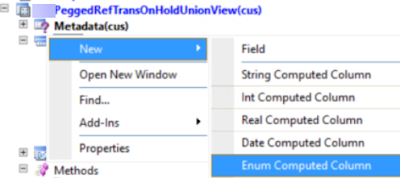
Say, we need to add a computed column as a result of OR function over two other columns of Boolean type:myPPOFirmDisableForSalesLine and myPPOFirmDisableForTransferLine.


Create a new field myPPOFirmDisable as Enum Computed field


and point it to the following method.


private static server str myPPOFirmDisable(int _tableNum)
{
    DictView    ctView      = new DictView(tableNum(myPeggedRefTransOnHoldUnionView));
    str         sTransType1 = SysComputedColumn::comparisonField(identifierStr(myPeggedRefTransOnHoldUnionView), identifierStr(mySalesTableOnHoldView),  fieldStr(mySalesTableOnHoldView, myPPOFirmDisableForSalesLine));
    str         sTransType2 = SysComputedColumn::comparisonField(identifierStr(myPeggedRefTransOnHoldUnionView), identifierStr(mySalesTableOnHoldView),  fieldStr(mySalesTableOnHoldView, myPPOFirmDisableForTransferLine));
    str     sRet        = '';

    sRet =
            SysComputedColumn::or2
            (
                SysComputedColumn::equalExpression(sTransType1, SysComputedColumn::returnLiteral(NoYes::Yes)),
                SysComputedColumn::equalExpression(sTransType2, SysComputedColumn::returnLiteral(NoYes::Yes))
            );
    sRet =
        SysComputedColumn::if(sRet, SysComputedColumn::returnLiteral(NoYes::Yes), SysComputedColumn::returnLiteral(NoYes::No));

    return sRet;
}

The whole point is to create a string with an SQL statement as a result in static method. There are a lot of standard functions in SysComputedColumn class aiming to help with syntax.

As you can see in this example it is not enough to get a logical comparison result at the first sRet assigning. The latter must be converted explicitly to an SQL string as it goes at the second step.

Finally we get the following string as a part of the whole SQL statement.

CASE WHEN (T1.MYPPOFIRMDISABLEFORSALESLINE = 1) OR (T1.MYPPOFIRMDISABLEFORTRANSFERLINE = 1) THEN 1 ELSE 0 END

Wednesday, January 23, 2019

bugs in SysLookupMultiSelectGrid class and form

You can find a lot of example about how to support multiple selection lookups. AX 2012/D365 provide us with SysLookupMultiSelectGrid class and form to implement such scenarios.

There are two bugs however still existing in the standard code.

SysLookupMultiSelectGrid class, method lookup() must be as follows in order to refresh Query in case QueryRun is given.


// the standard method does not update the query in case if queryrun is given
public static void wblLookup(Query _query, FormStringControl _ctrlIds, FormStringControl _ctrlStrs, container _selectField, queryRun _queryRun = null)
{
    SysLookupMultiSelectGrid    lookupMS = new SysLookupMultiSelectGrid();

    lookupMS.parmCallingControlId(_ctrlIds);
    lookupMS.parmCallingControlStr(_ctrlStrs);
    lookupMS.parmQuery(_query);
    lookupMS.parmQueryRun(_queryRun);
    if(_queryRun)
    // Begin: Alexey Voytsekhovskiy
    {
        lookupMS.parmQuery(_queryRun.query());
    }
    // End: Alexey Voytsekhovskiy
    lookupMS.parmSelectField(_selectField);
    lookupMS.run();
}

SysLookupMultiSelectGrid form, method executeQuery() on common data source must be as follows in order not to consider referenced data sources, which may come with a given query.


public void executeQuery()
{
    QueryRun qr;
    Query lookupMultiSelectQueryCopy = new Query(lookupMS.parmQuery());
    FormRun formRun;
    FormDataSource formDataSource;
    int dsCount, i = 1;
    Common formDataSourceCursor, queryRunCursor;

    // Always use the query defined on the SysLookupMultiSelectGrid class. Note that a copy is used
    // so that any modifications made to the Query by the Form at runtime aren't fed back through
    // the next time the lookup is presented to the user. (The Query is used to define which fields
    // are present on the Form during lookup construction. Therefore, if any fields are added at runtime
    // by the Forms engine, duplicated or non-original-Query defined fields may be presented on the
    // 2nd or later presentations of the lookup if a copy isn't used.)
    this.query(lookupMultiSelectQueryCopy);

    // check if user has set any queryrun. If yes, that means the cursors are set by user explicitly,
    // usually the case where query contains tmp tables and needs to be populated.
    qr = lookupMS.parmQueryRun();
    if(qr)
    {
        formRun = this.formRun();
        dsCount = formRun.dataSourceCount();

        // get data source from query run, get the cursor and set it on the form data source cursor.
        for(i = 1; i<=dsCount; i++)
        {
            formDataSource = formRun.dataSource(i);
            if(formDataSource
                            // Begin: Alexey Voytsekhovskiy
                            // we don't need a reference data source here!
                            && !formDataSource.isReferenceDataSource()
                            // End: Alexey Voytsekhovskiy
                            )
            {
                // get form data source cursor and set the queryrun cursor as data on it.
                formDataSourceCursor = formDataSource.cursor();
                queryRunCursor = qr.get(formDataSourceCursor.TableId);
                if(queryRunCursor)
                {
                    if(queryRunCursor.isTempDb() || queryRunCursor.isTmp())
                    {
                        formDataSourceCursor.setTmpData(queryRunCursor);
                    }
                    else
                    {
                        formDataSourceCursor.data(queryRunCursor);
                    }

                }
            }
        }
    }

    super();
}

Saturday, January 12, 2019

Date time range

Just for my records

 (dayRange(-5, 0))

 Taken from here

Thank you Martin!

Friday, October 19, 2018

Get table name from its id


static void wblTableName(Args _args)
{
    tableId tableId = 175; //1962; //2954; //101377;

    info(strFmt("%1 : %2", tableId2name(tableId), tableId2pname(tableId)));
}

Wednesday, October 17, 2018

How to get all related table ids from code

We can loop all relations on a table by code.


static void myGetRelatedTableNames(Args _args)
{
    myInExtCodeValueTable           myInExtCodeValueTable;
    int                             mapId;
    TableName                       relatedTableName;
    TableId                         relatedTableId;
    Set                             tablesIdsSet    = new Set(Types::Integer);
    Set                             tablesNamesSet  = new Set(Types::String);
    TableId                         tableId         = tableName2id(tableStr(myInExtCodeValueTable));
    Dictionary                      dictionary      = new Dictionary();
    SysDictTable                    dictTable       = dictionary.tableObject(tableId);
    DictRelation                    dictRelation    = new DictRelation(myInExtCodeValueTable.TableId);
    int                             mapCnt          = dictTable.relationCnt();
    container                       ret ;            
    str                             relationName;
    //create a maps of literals for all tables from the table relations
    // so that we could get tables names based on their ids
    // and if any new relation will be added to multiple external codes table
    // it is present automatically in this view
    for (mapId=1; mapId <= mapCnt; mapId++)
    {
        // elaborate if any table present many times
        relationName        = dictTable.relation(mapId);
        dictRelation.loadNameRelation(relationName);
        if(dictRelation)
        {
            relatedTableId      = dictRelation.externTable();
            relatedTableName    = tableId2pname(relatedTableId);
            tablesIdsSet.add(relatedTableId);
            tablesNamesSet.add(relatedTableName);
            info(strFmt("Table %1 - %2", relatedTableId, relatedTableName));
        }
    }
        
    ret = [tablesIdsSet.pack(), tablesNamesSet.pack()];
}


It can be useful in cases when we need, say, to open a form with a related record.


Here you can find a more elaborated example.

Wednesday, September 12, 2018

Lookup and Modified methods for FormReferenceGroup fields in D365

Let's say we need to keep in Purchase line a manufacturer code for a particular product. So each Product/Manufacturer code combination is unique.


Three tables are referenced via RecId fields.


So once Manufacturer code field is placed in the form, we end up with a FormReferenceGroup.


We can easily override its lookup method by subscribing to the relevant event on it.

 [FormControlEventHandler(formControlStr(PurchTable, myEcoResManufacturerProduct_myEcoResManufacturerProductRecId), FormControlEventType::Lookup)]
    public static void myEcoResManufacturerProduct_myEcoResManufacturerProductRecId_OnLookup(FormControl sender, FormControlEventArgs e)
    {
        PurchLine                           purchLine = sender.formRun().dataSource(formDataSourceStr(PurchTable, PurchLine)).cursor() as PurchLine;
        FormControlCancelableSuperEventArgs cancelableArgs = e as FormControlCancelableSuperEventArgs;
        
        myEcoResManufacturerProduct::lookupByItem(sender, purchLine.itemId);
        
        cancelableArgs.CancelSuperCall();
    }

public client static Common lookupByItem(FormReferenceControl _formReferenceControl, ItemId _itemId)
    {
        SysReferenceTableLookup sysReferenceTableLookup;
        Query                   query;
        QueryBuildDataSource    myEcoResMan;

        sysReferenceTableLookup = SysReferenceTableLookup::newParameters(tableNum(myEcoResManufacturerProduct), _formReferenceControl);
        sysReferenceTableLookup.addLookupfield(fieldNum(myEcoResManufacturerProduct, EcoResManufacturerRecId));
        sysReferenceTableLookup.addLookupfield(fieldNum(myEcoResManufacturerProduct, EcoResManufacturerPartNbr));

        query = new Query();
        myEcoResMan = query.addDataSource(tableNum(myEcoResManufacturerProduct));
        myEcoResMan.addRange(fieldNum(myEcoResManufacturerProduct, EcoResProductRecId)).value(SysQuery::value(InventTable::find(_itemId).Product));

        sysReferenceTableLookup.parmQuery(query);

        return sysReferenceTableLookup.performFormLookup() as myEcoResManufacturerProduct;
    }


But what if the user wants to create new values in appropriate tables if them do not exist yet?


We can catch the modified event in order to create new values before failing the validation.
However, given that its content may be changed, it is impossible to get access to its fields at design time.

We can do it during run-time by means of getting sought field form controls by their names and overloading then their Modified() methods. (see the similar trick for AX 2012 https://alexvoy.blogspot.com/2014/01/how-to-set-properties-for-reference.html)


The code you need to add.

[ExtensionOf(formStr(PurchTable))]
final class myPurchTableForm_PurchTableManuf_Extension
{
    private const  str          myFieldNameDisplayProductNumber    = 'EcoResManufacturerPartNbr';
    private const  str          myFieldNameEcoResManufacturerName  = 'EcoResManufacturerName';
    private FormStringControl   myFSCDisplayProductNumber;
    private FormStringControl   myFSCEcoResManufacturerName;
    
    // the only way to change the standard modified method for a control inside of a dynamically populated reference group
    // is to get it by its name looping all form controls of this group during run-time. then to overload it
    [FormEventHandler(formStr(PurchTable), FormEventType::Initialized)]
    public void PurchTable_OnInitialized(xFormRun sender, FormEventArgs e)
    {
        FormDesign                      formDesign = sender.design();
        FormReferenceGroupControl       formReferenceGroupControl;
        formReferenceGroupControl = formDesign.controlName(formControlStr(PurchTable, myEcoResManufacturerProduct_myEcoResManufacturerProductRecId)) as formReferenceGroupControl;
        this.registerManufacturerNameOverload(formReferenceGroupControl);
    }

    private void registerManufacturerNameOverload(FormReferenceGroupControl _formReferenceGroupControl )
    {
        int                                 i;
        Object                              childControl;
        FormStringControl                   formStringControl;

        for (i = 1; i <= _formReferenceGroupControl.controlCount(); i++) // FilterCategory is of FormReferenceGroupControl type
        {
            childControl = _formReferenceGroupControl.controlNum( i );
            formStringControl = childControl as formStringControl;
            if(formStringControl.DataFieldName() == myFieldNameEcoResManufacturerName)
            {
                myFSCEcoResManufacturerName = formStringControl;
                formStringControl.registerOverrideMethod(methodStr(formStringControl, modified), formMethodStr(PurchTable, myEcoResManufacturerName_modified_overload),
                    this);
            }
            if(formStringControl.DataFieldName() == myFieldNameDisplayProductNumber)
            {
                myFSCDisplayProductNumber = formStringControl;
                formStringControl.registerOverrideMethod(methodStr(formStringControl, modified), formMethodStr(PurchTable, myDisplayProductNumber_modified_overload),
                this);
            }
        }
    }

    /// <summary>
    /// We have to allow the user to insert any value, even though such a value is not found in the referenced table;
    /// then we will ask whether this new value must be created in the table and set this new value for the current record
    /// </summary>
    /// <param name = "_sender">EcoResManufacturerName</param>
    public void myEcoResManufacturerName_modified_overload(FormStringControl _sender)
    {
        myEcoResManufacturer myEcoResManufacturer = myEcoResManufacturer::findOrCreateByName(_sender.text());
        _sender.modified();
    }

    /// <summary>
    /// We have to allow the user to insert any value, even though such a value is not found in the referenced table;
    /// then we will ask whether this new value must be created in the table and set this new value for the current record
    /// </summary>
    /// <param name = "_sender">EcoResManufacturerName</param>
    public void myDisplayProductNumber_modified_overload(FormStringControl _sender)
    {
        Common          comm = _sender.dataSourceObject().cursor();
        PurchLine       purchLine   =  _sender.parentControl().dataSourceObject().cursor() as PurchLine;

        myEcoResManufacturerProduct myEcoResManufacturerProduct = myEcoResManufacturerProduct::findOrCreateEcoResManufacturerProduct(
                                                                                                        purchLine.itemId, 
                                                                                                        myFSCEcoResManufacturerName.text(),
                                                                                                        _sender.text());
        _sender.modified();
    }

}

Table methods

public static myEcoResManufacturer findOrCreateByName(myEcoResManufacturerName       _manufacturerName)
    {
        myEcoResManufacturer           myEcoResManufacturer = myEcoResManufacturer::findByName(_manufacturerName);
        if(!avrEcoResManufacturer)
        {
            if(Box::confirm("Do you want to creare new manufacturer?", strFmt(myEcoResManufacturer::txtNotExist(), _manufacturerName)))
            {
                try
                {
                    myEcoResManufacturer.EcoResManufacturerName = _manufacturerName;
                    if(myEcoResManufacturer.validateWrite())
                    {
                        myEcoResManufacturer.insert();
                    }
                }
                catch
                {
                    Error("Failed to create new manufacturer");
                }
            }
        }
        return myEcoResManufacturer;
    }


public static myEcoResManufacturerProduct findOrCreateEcoResManufacturerProduct(ItemId                         _itemId,
                                                                                    myEcoResManufacturerName       _manufacturerName,
                                                                                    myEcoResManufacturerPartNbr    _manufacturerPartNbr)
    {
        myEcoResManufacturerProduct    myEcoResManufacturerProduct;
        myEcoResManufacturer           myEcoResManufacturer;
        InventTable                     inventTable = InventTable::find(_itemId);
        // item and part number are given and exist
        if(inventTable.Product && _manufacturerPartNbr)
        {
            // such a manufacturer exists, so just try to find it for given combination
            myEcoResManufacturer           = myEcoResManufacturer::findOrCreateByName(_manufacturerName);
            myEcoResManufacturerProduct    = myEcoResManufacturerProduct::find(inventTable.Product, myEcoResManufacturer.RecId);
            if(!myEcoResManufacturerProduct)
            {
                if(Box::confirm("Do you want to create new part number", strFmt(myEcoResManufacturerProduct::txtNotExist(), _manufacturerPartNbr)))
                {
                    try
                    {
                        myEcoResManufacturerProduct.EcoResProductRecId         = inventTable.Product;
                        myEcoResManufacturerProduct.EcoResManufacturerRecId    = myEcoResManufacturer.RecId;
                        myEcoResManufacturerProduct.EcoResManufacturerPartNbr  = _manufacturerPartNbr;
                        myEcoResManufacturerProduct.EcoResManufacturerDefault  = NoYes::Yes;
                        if(myEcoResManufacturerProduct.validateWrite())
                        {
                            myEcoResManufacturerProduct.insert();
                        }
                    }
                    catch
                    {
                        Error("Failed to create new part number");
                    }
                }
            }
        }
        return myEcoResManufacturerProduct;
    }